Downlights are the most common light fitting in Australian homes built after 1990 — and in most cases they are also the easiest lights to make smart. You remove the old globe, insert a smart globe, restore power, and pair it in the app. No electrician, no rewiring. But there is one compatibility question to answer first, and getting it wrong is the main reason people end up with flickering lights.
What type of downlight do you have?
The two most common downlight types in Australian homes are:
-
GU10 (mains voltage, 240V): two short, thick pins that twist-lock into the fitting. GU10 downlights run directly on mains. Straightforward to upgrade — any 240V GU10 smart globe will work.
-
MR16 (low voltage, 12V): two thin, straight pins. MR16 fittings run on 12V DC, converted from mains by a transformer hidden in the ceiling. More complex — the transformer often needs replacing before smart globes work properly.
To tell them apart without pulling the globe out: GU10 pins are thicker and spread wider; MR16 pins are thin and close together. Or just read the marking on the existing globe.
GU10: a straightforward swap
- Turn off the circuit at the switchboard
- Twist the existing globe anticlockwise and pull it free
- Insert the GU10 smart globe — push in and twist clockwise to lock
- Restore power
- Pair it in the app — for most smart globes that is the free Smart Life app, then linked through to Google Home, Alexa or Apple Home
This is not electrical work. Changing a globe is something any homeowner can legally do.
MR16: the transformer problem
MR16 fittings use a 12V transformer, and not all transformers work with LED smart globes. The issue is minimum load: older magnetic (iron-core) transformers need a minimum draw to operate correctly, typically 20–40W. An LED smart globe draws only 4–8W, which falls below that minimum and causes flickering, early failure, or the transformer running hot.
The fix: replace magnetic transformers with modern electronic LED-compatible 12V units, which have no minimum load requirement. That is mains work, so it needs a licensed electrician — usually 15–20 minutes per fitting.
The better long-term fix: have the electrician convert MR16 cans to GU10 fittings entirely. It removes the transformer from the equation permanently, and every future globe swap becomes a DIY job.
If you would rather not touch the downlights at all
You do not have to start with the ceiling. Two alternatives worth considering:
-
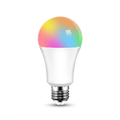
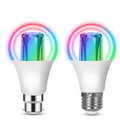
Smart globes in lamps and pendants — B22 bayonet and E27 screw fittings cover most Australian floor lamps, table lamps and pendant lights. Same automation, zero risk, and you can take them with you if you rent.
-
LED strip and bar lighting — under cabinets, behind a TV, along a hallway skirting. Low voltage, plugs into a normal power point, no electrician, and it changes the feel of a room more than people expect.
Both give you scheduling, dimming and voice control without going near a switchboard.
Setting up your smart lights
Once globes are installed and powered, pair each one in the Smart Life app, then link Smart Life to your assistant of choice — a one-time connection in Google Home, Alexa or Apple Home. Assign every light in a room to the same group, so “Hey Google, turn off the kitchen” controls all of them at once.
Frequently Asked Questions
What fitting is most common in Australian homes?
GU10 (240V) in homes built after 2005. MR16 (12V) in homes from the 1990s to early 2000s. Check your existing globe before buying.
Can I install smart downlights myself?
Changing the globe — yes, that's not electrical work. Any wiring, fitting, transformer or wall switch work requires a licensed electrician in every Australian state.
Why are my smart downlights flickering?
Almost always an MR16 transformer or an incompatible dimmer. Swap magnetic transformers for electronic LED-compatible units.
Can I skip the downlights entirely?
Yes — smart globes in lamps and pendants (B22/E27), or low-voltage LED strip lighting. Both give you scheduling and voice control with no electrical work.
Are smart LED downlights energy efficient?
Yes — 4–8W versus 35–50W for halogens. The saving depends on your tariff and how long the lights run each day.
Start where it's easiest
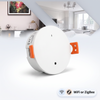
Browse PureNode's smart lighting — RGBCW smart globes for lamps and pendants, plus LED strips and light bars for ambient and under-cabinet lighting. All plug-in or screw-in, no electrician required. Pair them with a motion sensor and the lights come on before you reach for a switch.